Origins, Prophesies and the
Messenger
Origins
1. The origin of Buddhism (Ekayana) lies in
pre-Buddhist times. It starts with the Great Mother Tradition, subsequently followed by
Hinduism. Hinduism is the only religion (apart from Taoism) in which a continuity of the
Original Mother is still visible. Buddhism is a reaction to Hinduism. Logically, in order
to distinguish itself from its predecessor, the former had to change core teachings. At
the same time it was the beginning of patriarchal religion. Hence, especially insights and
concepts related to the "Eternal Feminine" had to be "transformed".
For instance, central to the Mother Religion was the "cycle of life and death".
It corresponded with feminine logic of menstruation, the change of seasons and the moon
phases. Because in archaic times the role of men was secondary (to that of women) - often
related to that of "vegetation god", in which they had to sacrifice themselves
to ensure the next harvest - men were seeking "a way out". They started the
"quest for immortality". However, the underlying Truth, namely the Mother as the
Vacuum - the Cosmic Womb - could not simply be ignored. That's why the Buddha not only
proclaimed his Awakening, but subsequently referred it to something beyond: Nirvana.
According to the Buddha Enlightenment has to be put into the context of Absolute
Emptiness, the Void. The latter, not the former has to be considered the Ultimate. In the
Sukhavativyuhasutra ("Land of Bliss") for instance, the Buddha is asking
Maitreya: "Did you see any being in the Land of Bliss, that has been originating from
the lap?" Few realize that with this the Buddha acknowledged
"Darkness" to be the Origin of Light - a memory of "the old times" - a
hierarchy that under the influence of patriarchal developments within Buddhism was soon
"forgotten". Not surprisingly, knowing that Buddhism originally was an
enterprise entirely aimed at overcoming "the cycle of birth and death" - the
feminine aspect of life - after all, a fact even not fully acknowledged by renowned
feminist scholars*. "Buddhahood" became a dimension for itself and on its own.
The "organic" relationship with the Absolute Void was pushed to the background.
It was the Yogacara school that re-opened the discussion though. It emphasized
"tathagathagarbha", the Womb. This school not only restored the original lineage
("Light born out of Darkness"), but had no problems with feminine connotations
of the Origin. A tendency which later - in a weakened and deviated form - was to be
continued by Vajrayana Buddhism.
* R.Gross "Buddhism
after patriarchy", 1993 State University of New York Press
In Great Mother Buddhism
the "cycle of birth and death" is
reunited with its Origin, overcoming 2000 years
of (hidden) dualism
2. This is confirmed by insights of those
who suffered the Great Death* (Tibetan: delog) as well as by modern physics. The Ultimate
is the dimension beyond Enlightenment and death, and appears to be a Vacuum. In the old
times this was described as the Abyss of the universe, the Womb or the Great Mother. In
recent times quantum physics assumes a "zero-point energy ocean" beyond the
tangible universe. The former, in its turn, originates from the Abyss beyond. The
foundation of life is a Vacuum "in which everything without exception continuously
dies and is being reborn in the selfsame Eternal Moment". Which leads to the concept
of the Absolute Void as the destroyer and creator of all life: both of Buddhahood (Light,
Being) and the relative world. Light is born out of Darkness. Light continuously returns
to Absolute Emptiness. It also dies. Because death and rebirth of the Light happens in the
selfsame Eternal Moment.....it only seems that the former is "Absolute". In
Reality, everything, even the Light is subjected to death and rebirth. Thus, Buddhahood is
born out of the Womb! The difference between the Great Mother and Nirvana is that the
former includes the dynamic aspect of "birth and death", while the second
excludes this. (Apart from the "formal" recognition that "Nirvana is
samsara"). By making "Nirvana" an abstract term the Mother was
stripped from Her dynamic (Womb!) aspects. It points at a fundamental difference between
the official (patriarchal) religion (with the masculine fear of life) and the more down to
earth common people, who instead kept an inclusive (matricentral, feminine) attitude. The
consequence of this is far reaching: do you accept "birth and death" as
belonging to reality or are you trying to escape from it? It is turning point in
contemporary Buddhism.
See: chapter "Threefold Realization"
Miroku Nyorei (Maitreya)
3. From the beginning of Buddhism there was a notion
of the underlying feminine principle, though. The Prajnaparamita is said to be "The
Mother of the Buddha's" or "The Womb of the Tathagatas". Existence is
bottomless, hence all dharmas have no self-existing identity. The primary matrix of
existence is called "Mother of Creation". The Mother principle is the space that
gives birth both to all Buddha's and to the phenomenal world. It is an ongoing process.
However, this insight doesn't go far enough. Here "Mother" means
"Essence of the Buddha's", which is equal to the Light, Buddhahood. The
confusion is, that the Light is also called Emptiness. Because in Enlightenment the ego is
dissolved into it. However, it is relative. Because the Light is born out of Darkness,
there must be something beyond "Emptiness", though. That's why the True Mother
is "Emptiness beyond Emptiness" or the Darkness from Which the Light
(Buddhahood) originates. Even in Tibetan Buddhism the insight in the true nature of
existence is confusing, mixing up "Emptiness" with "Emptiness beyond
Emptiness", e.g. in the biography of Machig Lapdron, an enlightened female
(1055-1145). There Tara said:
4. "Listen, yogini, your past is cleared from
your heart but I will explain it to you. The Great Mother is the void state of all the
dharmas which we call Mother of all Creation. The Mother is the Mother of the Buddhas of
the Three Times, the Dharmata of the Absolute State, beyond all obstructions, the pure
essence of egoless voidness-Prajna".*
* T.Allione "Women of
Wisdom", 1986 Arkana
5. Trungpa Rinpoche describes the primordial feminine as follows. Here the original Mother-principle is already abandoned (e.g. misunderstood!) in
favor of a "consort" of the Buddhas. Rather than Buddhahood being born
out of Her, is she born out of Buddhahood. It corresponds with the Shakti-principle of
Hinduism or Sophia in Gnosticism. How different this being from pre-buddhist times in
Tibet - called "Zan-zun" - in which the Ultimate was called "Sa-trig
er-sans" or "Great Mother of Space", confirming that originally She alone
was the Source of all life. He states:
"In phenominal experience, whether pleasure or
pain, birth or death, sanity or insanity, good or bad, it is necessary to have a basic
ground. This basic ground is known in Buddhist literature as the mother principle.
Prajnaparamita (the perfection of wisdom) is called the mother-consort of all the
Buddhas*...As a principle of cosmic structure, the all-accomodating basic ground is
neither male nor female. One might call it hermaphroditic, but due to its quality of
fertility or potentiality, it is regarded as feminine".
Chögyam Trungpa "Maitreya
IV", pp. 23-4
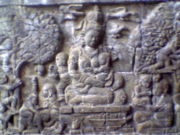
Predecessor/Goddess (Hariti) of Maitreya (Candi Mendut Java)
6. Why is it so important to know about the
true nature of "Emptiness beyond Emptiness?". Although Buddhists use it as a
concept very few know about it from their own Realization....During the centuries
Enlightenment was considered the Ultimate Liberation. Liberation consisted of two
essential parts. First of all, in Enlightenment the ego disappears. Thus, Realization
meant freedom from the (unconscious) identification with the small self. The second part
consisted of the cultural/religious environment. After Enlightenment the tradition would
take care of the newly awakened one, embedding him or her in the context of rules,
practices and conventions. The latter preventing a relapse into self-centered attitudes.
The current situation is totally different though. Enlightenment has become a commodity in
the worldwide "spiritual" market. It is not something to BE, but to HAVE. It has
become the victim of a materialistic attitude. Moreover, instead of leading a
selfless life - dictated by the tradition - spiritual Attainment has become an instrument
of being succesful in a extremely self-centered environment. "To make a
difference" as it is called. Enlightenment is thus often (mis)used for one's own
ego-purposes. A balancing tradition is totally absent. "Self-effort", the core
of the Buddha's preaching, has thus got an unexpected shadow part. With the ego as
underlying motivation the treasure of Attainment degenerated. The result is, that
Enlightenment has lost its liberating power.
6a. Some time ago the Buddhist world was
shaken by the news that Japanese Zen masters had supported the aggressive Japanese war.
Western Buddhists shed (crocodile) tears, apologizing for this dark past. Why am I
ironical here? Because "Zen at War" hasn't ended with WorldWar II. What we sadly
see nowadays is that "Zen" is shamelessly handing over itself to the interests
of big business. Under the guise of "self.improvement", many brochures of
"Zen"-centres openly promote their "service" with emphasizing the
"positive" benefits of Zen for the workplace.....By practising Zen one can
achieve greater "effectivity, flexibility, creativity", which improves your
performancein the office, increases your career chances....and this ad nauseam. The same
Zen people (teachers) who are so hyper-aware of the darker sides of Zen in the past,
display a blind spot for the darker side of Zen today. It means that their
lamentations are at best superficial, that they haven't done any serious attempt to
discover the true causes. Are they totally hypocritical? Or simply ignorant? Do they
realize their role in the HereNow? The current war of which they are a part - again as
aggressors - is that their collaboration with big business is further destroying the
earth. By improving the effectiveness of the managers, Zen is (indirectly) promoting
profit-maximalization of the company - and thus co-responsible for competition,
exploitation, worldwide consumerism, addiction, destruction of nature, war and injustice.
Zen at War today? I invite everybody to openly and courageously investigate this claim.
Only then Zen could free itself from its dark present.
7. If Enlightenment (relative Emptiness)
cannot save us anymore, liberation has to come from "something" that is beyond.
It is the Dimension of Absolute Emptiness. Only the One who has experienced Total
Annihilation, in which both the I and Enlightenment have disappeared altogether*, can
guide you here. It is corresponding with the notion of the Vacuum, in pre-Buddhist times
called the Great Mother. Buddha called it Nirvana. Contrary to Enlightenment the Vacuum
cannot be attained, realized or possessed. It can only be worshipped or surrendered to.
The ego has no chance to use it for its own purposes. Absolute Emptiness is thus the true
testcase for a truly ego-less attitude. You have no choice but to surrender without
expecting anything back. To give up your ego with the underlying expectation of getting
Enlightenment back isn't very difficult. In fact, you don't give up anything. Surrendering
to the Great Mother, just because of awe, adoration or gratitude, on the other hand, is
the way of true purity. It solves our current ego-problems. Hence, the era of Sakyamuni -
based on self-attainment - is over. It has become (too much) corrupted. Everyone who is
honest admits how deep the Dharma has sunk nowadays....Instead, realizing your Maitreya
Mind through unconditional surrender/ love is the only way true liberation can be
attained. It requires a total renewal of all aspects of the Way. That's why Maitreya isn't
just "a new Buddha". He is a totally new appearence. He hasn't come in his own
right but serves as an instrument of "Something" Beyond, the Dimension that
cannot be named, the true Unknown, the Great Mother. Hence, the new guideline to all
reborn Buddhists: "Take Refuge in the Great Mother, Maitreya Buddha, the new Dharma
and the new Sangha". Those who have eyes, see it.....
* See: "Threefold
Realization"
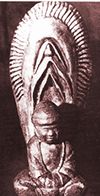
Buddha, born out of the Mother Lap. Japan 17th? century
Computer-manipulated picture from R.Camphausen "The
Yoni", 1996 Inner Traditions
8. Anne C. Klein in her book "The
Great Bliss Queen" talks about the biography of Yeshey Tsogyel, a Tibetan female
Enlightened One. She seems to coming close to the Truth when she is stating, that "in
Nyingma Great Completeness traditions, the womb imagery associated with Yeshey Tsogyel
suggests a Buddha nature (...) that is "not merely empty, but has the nature of clear
light" and "Here the ultimate empty nature itself is filled with positive
potential".* The confusion is about the identity of Emptiness ("birthless"
origin) and awareness, because eventually the "primordial emptiness proves to be
nothing but the internal clear light", e.g. Enlightenment"**. Not surprisingly
though, that she subsequently describes how to realize this innermost essence.***,
probably not realizing that this is the very core of patriarchal spirituality. She does
this in a feminist disguise, since she is talking about "how to become a Great Bliss
Queen". Unfortunately, the primordial Origin (the Womb, Absolute Emptiness) is mixed
up here with Her offspring: the Light e.g. Buddhahood. What has been overlooked here is
the hierarchy of "Mother and Son" (or Daughter). In reality the Ultimate is
Emptiness beyond Emptiness (the "Womb of Buddhahood"); it is the Great Vacuum
going beyond Buddhanature. It appears to be the Ultimate Bottomlessness. Why is this so
important? Obviously, because this is Reality-As-It-Is. Moreover, the Womb is beyond every
Realization, hence, It ("She") cannot be attained, achieved or possessed, only
worshipped. It is the end of a materialistic era, in which identification with
Enlightenment is being (mis)used in favor of influence and power. Buddhanature - the Light
- on the other hand, has to be understood as Her Lightbody, her Cosmic Son (Daughter).
Something that is granted to you, once your surrender is total. It is the foundation of a
carefree life based on effortlessness, grace, joy and gratitude, rather than ego-ambition.
Conclusion: The above mentioned book typically advocates "stealing of the female
secret", the replacement of the Realm of the Mother (Darkness) by masculine values
(Light). It parallels the transition between the original pre-buddhist feminine world and
early patriarchy in historical times. Again, it proves how difficult it is, to really
overcome the hurdles of patriarchy.
* A.C.Klein "Meeting the
Great Bliss Queen", 1995 Beacon Press, p. 160
** This is the core of the
confusion. It arises with identifying the Ultimate with Buddhahood. How did it come? Well,
to the ego Enlightenment is "Emptiness", because in Enlightenment the ego (self)
disappears into it. This is only half the truth, though. Because, in its turn,
Enlightenment (Buddhanature) "dies and is being reborn" in the Beyond, in
"Emptiness beyond Emptiness". Hence, the latter and not Buddhanature being the
Ultimate Reality (which I call the Cosmic Womb, e.g. the Great Mother).
*** ibid. p. 170
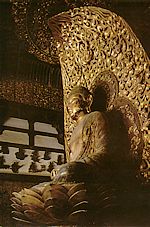
Amida Buddha sitting
on/emerging from the LotusWomb
9. The object of ultimate reverence thus being the
Womb! In Asia, from time immemorial, the Great Mother has been symbolized by a Lotus
flower. "Om mani padme hum" - the jewel in the lotus - means Being emerging from
the Cosmic Womb. A closer look at almost all images of the Buddha, e.g. celestial Buddhas,
Kuan Yin etc. reveals, that he (she) is sitting on a Lotus. It symbolizes the essence of
(Great Mother) Buddhism. The Lotus is the Womb from which Buddhahood arises! This way the
"memory" of the Great Mother has been preserved throughout the Buddhist world in
millions of images. Hence, Great Mother followers both revering the Mother and the Buddha
in the selfsame images. They may whisper "Womb of Buddhahood" or a similar
mantra, while prostrating themselves. In Japanese Tantrism (Shingon) images could be
very direct and concrete - a Buddha born out of the vulva - as a picture shows.*
Furthermore, the supreme all-embracing Matrix is called the World of the Mother-lap there.
It is described in the Dainichi-kyo/Mahavairocana sutra. Furthermore huge mandala's - with
428 different figures - have been painted in which the Mother-lap World has been
visualized.
* See above.
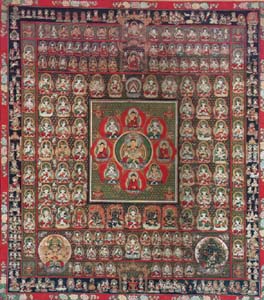
Womb Mandala
Taizokai (Mahakaruna gharbha mandala)
Even in Nestorian Christianity, the
"sect" that had penetrated China in the first centuries ACE, the key symbol is a
cross emerging from a lotus! It is an indication of the same - deeply hidden in the
archaic layers of consciousness - wisdom: Christ as the Son of the Mother.

10. In Buddhism another "detail" was
"forgotten". Buddha having got "his" Enlightenment under a BODHI-TREE.
Why under a Bodhi-tree? Why not in a sacred place, a meditation hall or just somewhere? If
you read the scriptures one cannot but sense, that there was something special about the
fact, that he was sitting under that tree. Was that tree somehow essential to his
Realization? Couldn't he have realized without it? Could the Bodhi-tree perhaps have
facilitated it.....The fact, that the tree was indispensable makes the latter very likely.
So, what does the Bodhi-tree stands for? Is it just like any tree? You will guess it, it
is not. The BODHI-TREE* connects to very ancient times, hence its magical/mystical aura.
Actually, it symbolizes the Tree of Life, which in turn reflects the Primal Mother of
pre-historic times. It was the key symbol of the Sumerian MotherGoddess Inanna, later
spreading into all directions. To the West (MotherGoddess Asherah, Canaan), to the
North-East (Taoist Mother Hsing Wang Mu) and to the East (the Harappa culture of the Indus
delta). The Tree of Life (think of the Bible-story in Genesis) stands for the Orgin, from
which all life emerges. Apparently, at the time of Sakyamuni's life it was still such a
powerful symbol, that it couldn't be neglected. Applied to the Enlightenment story it
means, that Buddha was GRANTED Enlightenment. It was granted by the Primordial Mother,
symbolized by the Bodhi-tree! Typically, patriarchal mind subsequently denied its
ancestral roots, boasting that Enlightenment is the result of self-effort, only. You have
to pay dearly for cutting yourself off from your maternal Origin, though. That's why in
current Buddhism the elán has dried up. Even Buddhists have to face the fact, that, if it
wants to renew itself, it has to go back to its (pre-Buddhist) Source.
* The Bodhi-Tree is the symbol of
our new Eco-Dharma! Personally, an indigenous healer of the Caribbean once recommended me
to do the same: to go to Haiti, sit under a sacred tree and wait until he tree would
give my new name.....only then I would b able to becom a healer like herself. It is
equal to the Dragon-Flower tree story of the Maitreya
Dragon-Flower Assembly. Only if that tree starts flowering - if the Mother starts
flowering - then A New Era will evolve.
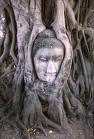
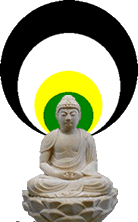
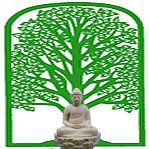
Buddha: Son of the Mother
11. Even from an angle, where one would expect to find
nothing but "masculine purity", namely Theravada Buddhism, reminiscences of the
Great Mother can still be found. In his excellent essay "The Great Goddess Today in
Burma and Thailand: An Exploration of Her Symbolic Relevance to Monastic and Female
Roles"*, John P. Ferguson makes it clear that "Theravada Buddhism, it would
seem, built its religious edifice upon a preexisting structure in which worship of the
Goddess was fundamental". One of his main thesis is that Buddhism is a reaction to
the power of the Mother. "To the Buddhists the Great Goddess is a veritable matron of
suffering (because of the inability to resist Her attractions), the primal cause to all
mankind's troubles. She makes us love Her more than we should". Hence, nonattachment
to be the core of Buddhist teachings. The interesting nuance, however is, that the Buddha
did not renounce the world because of hatred, but because he loved it too much. That
means, that there is "a positive valorization of the world of the Great Goddess at
the very moment the Theravada Buddhist rejects it". Furthermore it is stated, that
the Goddess appears at crucial moments in (Theravada) Buddhist life. First of all, the
Buddha's Enlightenment would not have been possible, without the Goddess' interference
under the Bodhi tree**, in which She at a crucial moment, after the Buddha touched the
Earth (Goddess) as a cry for help - which ever since became one of the main mudra's
- "made such a fearful sound, that Mara (the god of desire and illusion, trying to
distract the Buddha) fled. "The Buddha's Enlightenment is thereby assured by the
timely intervention of the Great Goddess Herself".
* In: James J.Preston "Mother
Worship", 1982 Chapel Hill
** As stated above, the Bodhi Tree
itself being a symbol of the archaic Tree of Life, in its turn being a symbol of the
Original Great Mother. The hidden meaning could be, that - contrary to his own claims
- the Buddha didn't realize through self-effort, but rather was granted it by the Great
Mother: the Light that was born out of Darkness. Isn't that fascinating? See
literature about Sumeria and Harappa or Indus culture. See also Pali sources, found
mainly in Burma.
Maitreya
12. The second very interesting phenomenon is that of
the seasonal retreat of young Buddhist novices. "It may be merely coincidental with
slack labor periods that males who choose to become temporarily monks pick the period when
the rains fall upon the newly planted rice and come out of the monasteries again at
harvest time when labor demands are greatest. Such an explanation is traditional. Yet
there is reason to see the timing as part of a much deeper and more meaningful statement.
In the whole of southern Asia, the fertility of the crops was often ensured by sacrifice
of things dear to the people. Vegetation rituals were developed that included human
sacrifice and dismemberment for burial in the fields, animal sacrifice with blood poured
into the ground for the Earth Goddess, and various planting and harvesting dramas to
please the Goddess with gifts and kind words.* Theravada Buddhism evolved in the midst of
such ancient beliefs and practices. It is not impossible that the self-denying monks
sequestered in their compounds for the growing season were a revolutionary substitute for
the ancient sacrifices to the Goddess. If such a hypothesis is correct, then the monks of
Theravada Buddhism can be seen as silently but dramatically sacrificing, not their bodies
or their blood, but their desires".**
* These rituals were an important part
of almost all prehistoric Mother-oriented cultures, both in Africa, Europe, India,
Indonesia (Rice-Goddess), China and South America.
** Ibid. p. 289
13. Tibet used to be a largely matriarchal society, in
which people worshipped the Great (Mother)Goddess. Its women were strong, independent,
while taking care of the community. Some pockets have still survived, like the Mosuo tribe
in Sechüan. The structure is matrilinear, e.g. the central positions are inherited by
women. They still worship the Goddess in the form of the mountain that lies next to their
lake. No wonder that Buddhism with its misogynic philosophy encountered strong resistance.
However, through a clever integration policy it succeeded in getting the upper hand. Ever
since, the Mosuo are ruled by a patriarchal monks class. The same happened in Tibet many
centuries ago. In order to make its rule sustainable it had to submit the Mother e.g.
feminine dominance. This is what they did. Instead of recognizing the Cosmic Mother as the
Ultimate Reality, they started using Her Power to favour their own male spiritual
ambition. So they turned reality upside down. Not the Cosmic Womb - Absolute Emptiness
(Emptiness beyond Emptiness) - was considered the highest spiritual principle, but
Her derivative - BuddhaNature (Emptiness) - was. In Reality, the latter is born out of the
former, though. Hence, the Son should pay tribute to the Mother. This was cleverly
reversed in such a way, that the Goddess was made subordinate to the ruling Lama class.
She had to serve male spiritual realization through sacrificing Her female energy, a
victim on the altar of male supremacy. The underlying emotion is fear for the feminine.
Tantric practices - in which the initiate steals the energy of a female "helper"
- are a way of exploiting and controlling it. Obviously, here the Truth is being
manipulated. Under the flag of "spiritual wisdom" Reality - the Mother as the
Origin of all - is grossly distorted, a fatal ignorance, indeed. Surrender vs
ego-inflation, purity of intention vs (limitless) greed for power.....that's where it is
all about.
14. Insight is not complete without understanding the
Buddhist concept of compassion. Many Westerners think that it is similar to the Christian
idea of love. This is not so. Although many Buddhist leaders have strategic goals in mind,
purposely remaining vague in this regard. They talk about compassion, leaving it to the
audiance how it should be interpreted. Originally, Buddhist compassion is describing the
quality of the Enlightened Mind. Which means that somebody who "got enlightened"
automatically - and without any effort, obviously, because the ego has disappeared -
posseses inclusivity*. Hence, it is a State of Mind. Buddhist philosophy subsequently
added a purpose to it, namely "compassion as the desire that everyone would reach
that same state of freedom". Freedom in the sense of "being freed from the cycle
of birth and death" (of life!). Enlightened Ones thus don't have to reach out to
others. Instead, their attitude is "become like me". No reaching out to the
world with its suffering. The world itself is suffering, after all. So,
"compassion" is the desire to heal people from the world rather than healing the
world itself. The world as such cannot be healed, for it is the cause of suffering from
which one has to escape. Socially, "compassion" can only be
"exercised" by the monk elite. They only posses universal wisdom. "Lay
people" and their problems are only relevant, in as much they want to escape from
"samsara". This deeply engrained dualism has led to horrendous situations: an
arrogant monk's elite on the one hand and an ignorant, empoverished, miserable lay
population, often ruthlesslessly exploited by the former. "Compassion", despite
its "mystical" aura, proves to be self-serving. Don't buy these talks about
"compassion", unless it becomes utterly sure, that true inclusivity - embracing
ALL levels of existence simultaneously and equally - is meant. The "highest
state" is measured by the love it has for the lowest.....
* Which in itself is correct.
Prophesies
15. The appearance of Great Mother Buddhism in
modern times has been prophesied by Chinese popular religious literature, called
Pao-Chüan. Although the origins can be traced back to the fourteenth century, the first
books were composed in the sixteenth and seventeenth century. The exact meaning of
Pao-Chüan is "precious book". Quite contrary to the official monastic
scriptures, the precious books were written by religious lay people. Characteristic of
this literature is that they emphasize "the restoration of the primordial
unity", both spiritual and worldly. The members of these Buddhist sects not only
hoped for personal liberation, but also for a "better world". These people were
more or less embracing "all three teachings" (Taoism, Confucianism and
Buddhism). Hence, respect was paid to life-giving powers and persons such as heaven,
earth, parents and teachers. There was an awareness about the continuous decline of
religion, including monastic and priestly Buddhism, so that eventually common people
became the representatives of the Way. They bore the true tradition and were neither
clerical nor lay.
16. The Pao-Chüan literature is unique with regard
to its mythical background. Unlike the mainstream Buddhist definitions the Ultimate is
described as the "Eternal Venerable Mother" (Wu-sheng lao-mu). According to
these myths the Eternal Mother sends down to earth ninety-six myriad's of her children.
Although they are originally all "Buddha's and immortals", once on earth they
forget their true home in paradise and become attached to fame, profit and sensual
pleasures. Trapped by their desires, they are immersed in samsara, the "sea of
suffering", repeatedly encountering death and rebirth, and enduring punishments in
purgatory. The Venerable Mother, grieved by this, sends down messenger deities to remind
her lost children of their true nature and the way home*. It is likely that pao-chüan
literature links the ancient notion of the prehistoric Great Mother to the outcome of
later spiritual practice. To it he Void isn't just an "abstraction" (Nirvana),
but the Realm which includes the dynamic aspects of life - birth and death - a
"compassionate Mother" who cares about the world.
"Heaven" (the Light,
Buddha) and earth continuously die
in the Great Mother, while being reborn in the
selfsame eternal moment
The Messenger
17. The main messenger of the Great Mother is
Maitreya Buddha. His mission is "to show the lost and ignorant the way home to the
Eternal Mother". Several texts emphasize his importance as a teacher and a savior. He
is supposed to "take charge of religion (chang chiao) and of the world (chang
shih-chieh). His task is "to restore the original wholeness" (shou-yüen).
Maitreya descends in a time of chaos and decay with the promise of world renewal. In the
"Huang-chi- chiu-lien" pao-chüan Maitreya is first protesting against his
mission, because of too much attachment to the joy of paradise in which he resides
("Tusita Heaven"). But finally he is giving in and descends to earth and -
because of "his weaknesses in the past" - manifests himself as an ordinary
human. His call to the people is to "realize their true nature, recognize the true
savior (himself) and their way home to the Eternal Mother". These promises gain
momentum, as they are placed against a time of terrible chaos, the end of the world,
warfare and death...with the hope that the true Buddha (Maitreya) will appear, so that the
Mother's children "can escape all forms of calamity and difficulty". Maitreya is
said to put "the world in order", which suggests a radical, militant and
political role as well. It used to be the reason for suspicion from the side of
authorities.
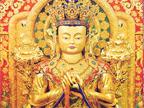
Maitreya
18. "At that period, brethren, there will arise in the world an
Exalted One named Metteya, Arahant, fully Awakened, abounding in wisdom and goodness,
happy, with knowledge of the worlds, unsurpassed as a guide to mortals willing to be led,
a teacher for gods and men, an Exalted One, a Buddha even as I am now. He, by himself,
will thoroughly see and know, as it were face to face, this universe, with its world of
the spirits, its Brahamas, and its Maras, and its world of recluses and Brahmins, of
princes and peoples, even as I now by myself, thoroughly know and see them. The truth (the
Norm) lovely in its origin, lovely in its progress, lovely in its consummation, will he
proclaim, both in the spirit and in the letter; the higher life will he make known, in all
its fulness and all its purity, even as I do now. He will be accompanied by a congregation
of some thousands of brethren, even as I am now accompanied by a congregation of some
hundreds of brethren.
Cakkavatti-Sihanada Suttanta. The Mahabodhdi Society
Translation.
(From the Chinese-Sanskrit sources.)
19. "In the old days when the Tathagata was living at Rajagriha
(Wang-she), on the Gridhra-kuta(others think at "Benares") mountain, he spoke
thus to the Bhikshus: 'In future years, when this country of Jambudvipa shall be at peace
and rest, and the age of men shall amount to 80000 years (sic), there shall be a Brahman
called Maitreya (Sse-che). His body shall be of pure gold, bright, glistening and pure.
Leaving his home he shall become a perfect Buddha, and preach the threefold("Thrice
repeated") Law for the benefit of all creatures. Those who shall be saved are those
who live, in whom the roots of merit have been planted through my bequeathed Law. These
all conceiving their minds in profound respect for three precious objects of worship,
whether they be already professed disciples or not, whether they be obedient to the
precepts or not, will be led by the converting power (of his preaching) to acquire the
fruit (of Bodhi) and final deliverance. Whilst declaring the threefold Law for the
conversion of those who have been influenced by my bequeathed Law, by this means also
hereafter others will be converted."
Si-Yu-Ki. Vol. 2. Pp. 46-7.
According to Buddhist scripture, Gautama predicted that at some
future time another Buddha would come to help men set up an ideal kingdom of righteousness
and peace. The coming Buddha is called Mettaya, (Sanskrit: Maitreya) meaning
"love." In Theravada temples he is portrayed as a king rather than a monk
because of his role as a ruler in the new world order. Most of the time the Maitreya hope
has not been a major part of Buddhist piety. However, when Theravada monks and laymen were
freed from colonial subjection after World War II, in the excitement of win- ning their
independence, a new age seemed at hand. If the first 2500 years was a time of toil and
trial for them, the next 2500 years would be filled with dazzling victories.
According to the oldest texts, Buddha does not promise to come back;
what he promises is that Maitreya will become the next Buddha whose success will be far
greater than his own. Also, Maitreya will bring to fulfillment the Buddhist Dhamma and
inaugurate an era of cosmic bliss; he will do so as a teacher and holy man. As the
Dialogues of the Buddha report, Maitreya will be "fully awakened, full of wisdom and
a perfect guide, himself having trodden the path to the very end; with knowledge of the
worlds, unsurpassed as an educator, teacher of gods and men, an Exalted Buddha.... From
his own understanding and penetration of it, he will proclaim (the nature of) this
universe...and (the nature of) living beings. And he will proclaim the teaching that is
lovely in its origin, lovely in its progress, and lovely in its consummation...the higher
life will be made known in all its fullness and in all its purity.... He will be the head
of an order of many thousand monks, just as in the present period I (Gautama) am the head
of an order of many hundred."
In the past Buddhism offered to the Orient the hope for the highest
kind of individual contentment based on liberation from worldly cares. Without denying
this supreme goal, Buddhists today stress the value of creating a just and prosperous
social order. This is the necessary prerequisite for the pursuit of the higher joys of the
spirit; only in a just environment will men have the security and leisure they need for
spiritual advancement. Gautama Buddha and Maitreya Buddha actually complement each other,
the first reminding us of individual self-perfection, the second challenging us to bring
about the messianic age of justice and material abundance for all.
By Theol. Prof. Young Oon Kim
The most prominent text
revealing Maitreya's descent to the earth is the "Ku Fo tang-lai hsia-sheng Mi-le
ch'u-hsi" (Cause of Suffering and the Arrival of Maitreya Buddha from the West to the
World)...It says:
20. The Buddha of the past, Dipamkara, the historic
Buddha Sakyamuni the younger and Maitreya the eldest, all three sons of the same Eternal
Mother, all three working at the Dharma and each successful in their own Way are gathered
to discuss the succession. Who is most suitable to rule the world and to save the people,
that is the question. All three decide to go into meditation, each with a golden staff in
the hand. He, to whose staff will first sprout the dragon flower, will be sent to the
world. Who will have his flowering later has to wait. Against the rules Sakyamuni opens
his eye already after one day, seeing that Maitreya's staff is decorated with the dragon
flower with the ten thousand golden light rays. He sneakily steals the flower putting her
on his own staff. Immediately the flower feels unhappy, is sagging and looses her light
and radiation. Two days later Maitreya's heavenly eye opens and sees that his brother has
stolen the dragon flower. Thus He spoke to Sakyamuni: "today the entire world has
been given to you, but how can you be a refuge to the people? Because of this theft
nothing will ever reach its perfection. Under your rule of 3000 years the people will be
tossed about between wealth and poverty, happiness en suffering, needs and discord. There
will be conflicts between states, crime and unrest. The people will be misled by the king
of the devils. There will be big disasters, like the eight big problems and the last big
catastrophe of the earth. Everything because of your deceit Sakyamuni". Shortly after
the Eternal Mother, Kuan Yin and several other Buddha's meet on the Holy Mountain. They
are moved by the suffering of the people on earth. Although the 3000 years are not yet
completed, Maitreya is requested to move forward from his "Western forest" in
order to save the people.
Maitreya: the Buddha with
many appearances. His main task
is to bring spiritual deliverance, restoring primordial unity,
while taking charge of religion (chang chao)
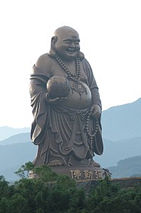
Maitreya
Another text ("Li-chih pao-chüan": the precious
book on establishing a new world) puts it like this:
21.
...the Buddha Maitreya comes to take charge of
religion, he has put aside his immortal clothing and descended to the secular world. When
Sakyamuni Buddha saw him his mind was scorched (hsin chiao-tsao)...Now the time has come,
the red flower withers, and the white flower blooms; only now does Sakyamuni withdraw from
his position, and Maitreya laughs out loud. The great kalpa has arrived, and Maitreya has
ascended to the throne (teng liao chi). He kept his hair, and changed his clothing. He put
on the gauze hat and round-collared robe (of an official),...and appeared in the world
(ch'u-shih). Who in the world knows this? Maitreya Buddha is in charge of the world (chang
ch'ien-k'un)...
22.
A country in which Maitreya (Mireuk-sa) is
particularly revered is Korea. Because Koreans originally came from Central Asia and
because Central Asia still had memories of Mesopotamia, the Korean Mireuk-sa includes a
variety of "functions", formerly belonging to the Vegetation Gods. First of all,
claimed to be a member of a youth organization ("Hwarang"), he stands for a
compassionate caretaker, later to be changed into a famous warrior. His original aspect of
"bringer of renewal" wasn't forgotten, though, hence, in later centuries
embodying fruitfulness and even fertility. As such he became very popular with women, in
fact, to this very day. It lasted until the last centuries before Maitreya also took upon
him the mission of political reform. However, because of the strong fragmentation of the
Maitreya sangha, it never came to any coordinated action in the social arena. Throughout
the country, one may find several outstanding Mireuk statues and temples. Some are
depicted with a kind of platform on their heads, someting that could possibly be linked to
his oldest "manifestation", in which he was considered to take care of
("bear") the world. Because of the interreligious situation, Korea could (again)
become an important factor in spiritual renewal, not only for the own country, but for the
world, as well.
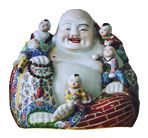
Hotei-Maitreya
Goddess Hariti-Maitreya
23.
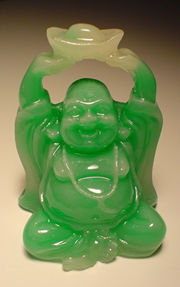
The "Laughing Hotei - Mi-Le or Maitreya -
Buddha", this popular image of Chinese lay people typically incorporates motherly
characteristics. He reminds us of the Great Mother: "feminine appearance", the
images with many children on his/her lap and arms. He is often portrayed with the symbols
of the "raised arms" (pre-historic origin) supporting the boat with the cosmic
egg, which in Chinese mythology symbolizes the "Yüanbao" or Original Treasure,
which stands for the overflowing Emptiness, the Womb with Her offspring, e.g. Buddhahood.
Some statues portray him inside the Cosmic Egg, which emphasizes the inseperable
connection of mankind and the Cosmic Mother. A fascinating tool is his "Bottomless
Bag" or Bu Dai. It is said that this bag contains all human seeds. Everything is
sucked in, while never getting full. It symbolizes the death-aspect of the Cosmic Mother.
Affluence and Destruction are Core characteristics of the Cosmic Womb, hence Maitreya
Buddha is the One Who knows the Ultimate. His historic background can be traced to the
Great Mother of the Middle East. In the Indus-Valley Culture She was transformed to a
fertility goddess, who much later became part - as the goddess Hariti - of Buddhism. A
Chinese pilgrim "took her" to China, where she was transformed into a man: our
Hotei (Maitreya) Buddha. A clear example how feminine myths were changed into masculine
ones! As is often the case, male redefinitions upgraded his status: from servant to being
"a God". However, the name Maitreya still reminds us of the original
situation. It could very well mean "servant of the Mother", from Maitri or Matri
("Mother"). Hotei's appearence clearly shows feminine traits. He therefore can
be considered as a happy inner "marriage" between femininity and masculinity,
indeed, a true androgynic avatar.
24.
True insight includes Maitreya as a servant of the
Great Mother. It is the turning point in Buddhism as we know it. Sakyamuni propagated
"Enlightenment as the fruit of self-effort"*. However, in these materialistic
times greed has devaluated Buddhism's most cherished treasure. Maitreya came into this
world without any effort on his part, though. He descended rather than ascended. His
Enlightenment is a gift. But there is more about it. Because "he was sent" to
earth, he knows about his background, his "ancestry". His Light Body originates
from Primordial Darkness, from the Cosmic Womb or Great Mother. Hence, he is not a Buddha
in his own right, but acts according to Mother's instructions. He teaches people - often
after a period in which you have exhausted yourself in self-effort - how to "return
Home". It is a true breakthrough, in which the age of decline is turned into renewal.
Hence, every Maitreya Temple/ Center/ Organization/ Group around the world may request for
initiation into the true mystery: to (re)link Maitreya as the servant of the Great Mother,
thus becoming part of the worldwide Mission of transforming Self and Society.
* However, the imagery of the Bodhi
Tree - the ancient Tree of Life, symbol of the Great Mother, under which the Buddha
attained Enlightenment - suggests, that the Mother "facilitated" him......
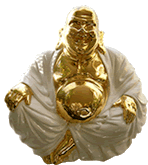
Maitreya
25.
Your Prayers Have Been Answered!
Friends, as you know Green Buddha
Maitreya is one of the manifestations of the Ultimate...... others are e.g.
"Servant/Messenger of the Great Mother", "Green Man" or "the
Friend"......after 33 years of preparation and reluctance he is overjoyed with
the prospect of meeting you soon.....So, you don't have to wait for his coming,
anymore......In fact, he has already descended......After many years of reluctance the
Mother didn't give him a choice......She revealed Herself to him, not as a concept,
idea or image, but through Her very Essence...... Therefore, a New Era has begun......He
is very happy to see, that his arrival has been expected......You worked so hard to make
his coming a joyful event......You have prepared the people well!.......On the other hand,
his appearance will not entirely comply with your ideas of how the Messenger looks
like.......The Transcendence has its own way of manifesting itself!......Being Nothing, he
is everything......Emptiness is including all forms, after all......Be sure, the prophesy
will materialize itself in a wonderful way......The world is in desperate need of peace
and happiness, love and friendship, healing and justice, prosperity and
sustainability.....he is about to depart from his Western Forest and will soon be welcomed
in your Beautiful Country......green is his color......he is sure your reception will be
overwhelming......Send your messages to all directions, so that everybody can
participate.......Once a beginning is made, through mutual cooperation his WorldWide
Mission will start spreading all over the globe.......
Her Blessings to you all!

Literature
* Daniel L.Overmyer
1. "Attitudes Toward the Ruler and State in Chinese Popular
Religious Literature", Harvard Journal of Asiatic Studies, Vol.44., NR.2.
2. "Religions of China", 1986 HarperSanFrancisco
3. "Messenger, Savior, and Revolutionary" in A.Sponsberg & H.Hardacre in
"Maitreya, the future Buddha", 1988 Cambridge University Press
4. "Folk Buddhist Religion", Dissenting Sects in Late Traditional China, 1976
Harvard University Press
5. "The Flying Phoenix" (with David K.Jordan), Aspects of Chinese Sectarianism
in Taiwan, 1986 Princeton University Press
6. "Precious Volumes", An Introduction to Chinese Sectarian Scriptures from the
Sixteenth and Seventeenth Centuries, 1999 Harvard University Press
* Chun Fang Yu
"Kuan Yin", 2001 Columbia University Press
Back
Next

(Back to the start of Han Marie Stiekema's
website)
| HOME
| Autobiography | Personal
Reactions | Picture Gallery | Poetry | Q & A online
| MatriTalks |
2003 ?Copyright Han Marie
Stiekema. All rights reserved.
Everyone may use this website as a source of inspiration. However, since it is
freely given, no-one can claim, copy or derive any text, rights, position or status from
this website.